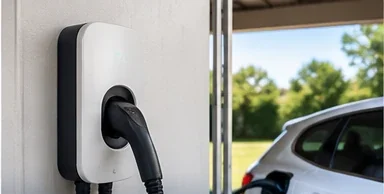
Fast, code-compliant home EV charging installations for Tesla, Rivian, Ford, Chevrolet, and all electric vehicles. Complete electrical panel load evaluations and Duke Energy incentive support.
Standard Level 1 120-volt charging provides only 3 to 5 miles of range per hour of charging—insufficient for daily Triangle commuting. A dedicated Level 2 240-volt charging station delivers 25 to 45 miles of range per hour, fully replenishing your battery overnight.
Because an EV charger is classified by the National Electrical Code (NEC Article 625) as a continuous load, it draws continuous heavy amperage for multiple hours. This requires precise circuit sizing, correct wire gauge selection, torque-calibrated connections, and panel capacity calculations to protect your home from overheating and fire hazards.
When selecting your charging configuration, understanding the engineering distinctions between hardwiring and a plug-in receptacle is essential:
| Feature | Hardwired Station | NEMA 14-50 Receptacle |
|---|---|---|
| Maximum Charging Speed | Up to 48 Amps (11.5 kW / ~44 mi/hr) | Capped at 40 Amps (9.6 kW / ~30 mi/hr) |
| Circuit Breaker Size | 60-Amp Dedicated Breaker | 50-Amp Dedicated Breaker |
| GFCI Breaker Requirement | Standard breaker (charger has internal GFCI) | GFCI Breaker legally required under NEC 2020/2023 |
| Nuisance Tripping Risk | Zero (no conflicting dual GFCI sensors) | Moderate (charger GFCI can conflict with breaker GFCI) |
| Outdoor Weather Rating | Excellent (weatherproof seal directly to conduit) | Requires heavy in-use weatherproof bubble cover |
Contractor Recommendation: We generally advise hardwiring your Level 2 station. It enables maximum 48A charging speeds, eliminates nuisance breaker trips, and avoids the additional cost of a specialized GFCI breaker.
Adding a 40A, 50A, or 60A dedicated load to your home's breaker panel requires careful mathematical verification. Under NEC Article 220, an electrical contractor must calculate your home's total existing continuous and non-continuous loads—including air conditioning, heat pumps, water heaters, and appliances—before adding an EV circuit.
If you are a Duke Energy residential customer in North Carolina, you may be eligible for the Duke Energy Charger Prep Credit. This program provides a one-time credit (typically up to $1,117 to $1,133 depending on specific utility service area rules) to help offset the electrical preparation costs of installing a Level 2 charger.
Note: The credit applies toward electrical contractor infrastructure work (panel upgrades, dedicated 240V branch wiring, conduit, and breakers) with an approved municipal permit and permanent NC EV registration. It does not cover the retail cost of the charger hardware itself.
We install all major brands and charging standards across the Triangle: