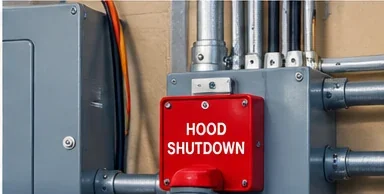
Expert installation, wiring, and testing of shunt-trip circuit breakers, make-up air shutdowns, and exhaust fan electrical interfaces. Fully compliant with NFPA 96 and NEC standards.
Under NFPA 96 (Standard for Ventilation Control and Fire Protection of Commercial Cooking Operations) and the National Electrical Code (NEC Article 210.18), any commercial cooking operation protected by a wet chemical fire suppression system (such as ANSUL, Pyro-Chem, Range Guard, or Buckeye) must be equipped with automatic fuel and electrical shutoffs.
When the fire suppression system activates, all electrical appliances located beneath the exhaust hood—including electric deep fryers, griddles, ranges, heat lamps, and convenience outlets—must instantly and automatically de-energize. This prevents electrical elements from reigniting grease fires after the chemical suppression agent discharges. This electrical shutdown is achieved through a specialized device called a shunt-trip circuit breaker.
A standard circuit breaker trips open automatically only when an overcurrent (amperage overload) or short circuit occurs. A shunt-trip breaker contains an additional integrated magnetic solenoid coil. When this coil receives an electrical voltage pulse (typically 120VAC or 24VDC) from an external microswitch on the fire suppression system, it mechanically forces the breaker into the TRIPPED position, instantly cutting power to the cooking appliance.
During a kitchen fire event, ventilation fans must respond with a precise, automated electrical sequence:
Important Clarification: LYF City Electric LLC is an electrical contractor. We do not manufacture or install the mechanical fire suppression cylinders, piping, or fusible links (which are provided by certified fire-protection contractors). We install the shunt-trip breakers, 120V/24V control wiring, microswitch terminations, and power circuits, coordinating seamlessly with your fire-suppression contractor for mandatory municipal acceptance testing.